


You've probably heard of the placebo effect as a term related to drugs and treatment methods. Placebo refers to positive effects that occur during the trial of treatment methods, effects that stem from psychosocial context rather than being directly attributable to pharmacological, physical, or chemical mechanisms. Placebo is the patient's expectation that a treatment will provide benefit, and this expectation can produce positive outcomes. To give a clearer example: it's when a so-called "sugar pill" — one with no active effect whatsoever — works because of the patient's cognitive belief. So can this mechanism also be used to make us feel full?
In previous articles, we talked about how our brain perceives food as more delicious depending on our "expectations." This expectation didn't stem only from the nutrients a food contained. Parameters completely independent of the food itself — where we eat, our memories, and who we're with — could change our perception of taste. Consequently, they also shaped our signals of satisfaction and fullness. After all these interesting findings, another question came to mind: can the sense of fullness experienced by people who consume the exact same food under the exact same conditions be manipulated through nutritional information?

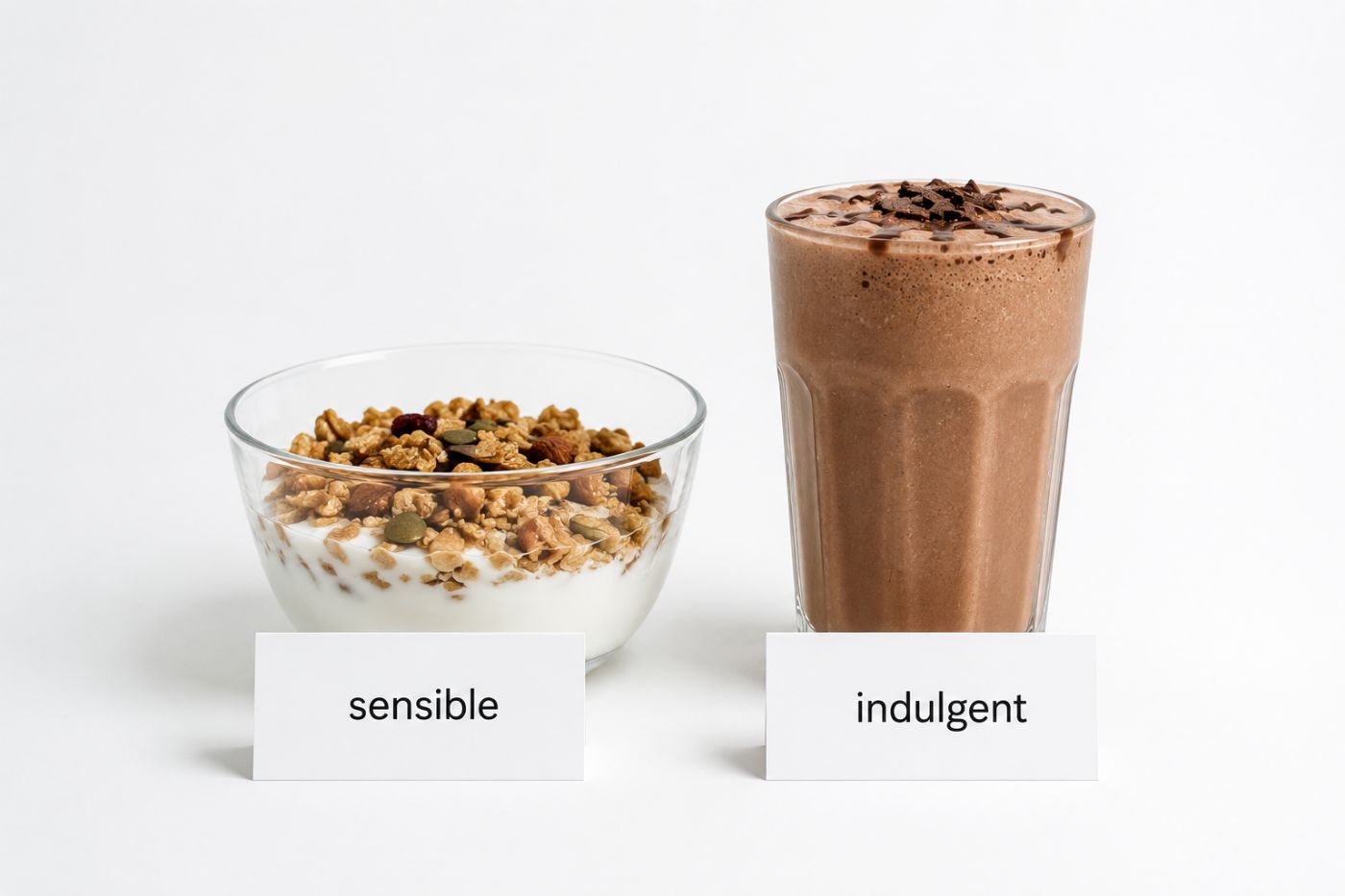
The study "Mind Over Milkshakes," published in 2011 by Alia Crum and colleagues, revealed how this physical sensation of fullness can be manipulated through the mind. The aim of the study was to measure whether ghrelin — known as the satiety hormone — changes depending on a person's "belief" about a food. The reason the word "belief" is used is that consumers were told different nutritional information about the exact same milkshake. In other words, people drinking milkshakes with identical calorie, fat, and sugar content were told, for one portion, that it was very rich in content, and for the other, that it had been reduced in calories.
Before going into the details of the study, let's look at what ghrelin actually is. Ghrelin is a biological peptide (i.e., a hormone) secreted from the stomach, and it is a physiological indicator of appetite. It rises before eating and falls after eating. It signals our brain to seek out food, and it also regulates our metabolic rate. When ghrelin rises, our appetite increases and metabolism slows; after eating, ghrelin drops, and this is perceived as a satiety signal.
Forty-six people who participated in the milkshake experiment were given the same 380-calorie milkshake on two different days. However, the nutritional information they were given about the milkshake they would drink was manipulated in two different ways. In the first session, the group was told they were drinking a 620-calorie milkshake with a "rich and indulgent" content. In the second session, they were told it was a "guilt-free," 140-calorie, reduced-energy drink. Participants' blood values were examined and ghrelin levels compared before consumption (i.e., during the anticipatory phase), during consumption, and 30 minutes after consumption.

In the group anticipating a high-calorie drink, ghrelin values rose sharply before consumption. After consumption, they likewise decreased with a steep decline. In the low-calorie group, a fairly flat line was observed, with almost no change occurring. Even though they consumed the same calories, the fullness participants felt — based purely on expectation — was completely different. This study was replicated in 2022 by Watson and colleagues, this time giving participants the same yogurt-granola combination while telling them it contained different nutritional values.
In the yogurt-granola study, no significant difference was observed in hormone levels. However, the "subjective" findings — that is, how full the study participants reported feeling — again varied solely based on the label information. Another interesting finding in this study was the different responses given by people who restrict what they eat, or who pay attention to low-calorie eating, both before and after eating the high-calorie food. In people who restrict their eating, the high-calorie food may have increased feelings of "guilt," and therefore did not increase appetite before the meal. In other participants, however, the food labeled as high-calorie increased appetite before the meal and increased the feeling of fullness after eating.

These studies show that a consumer's expectations and the information they have about a food are directly related to the feeling of fullness or satisfaction. Feeling full is related not only to what we eat, but also to what we want to eat. This is exactly why, as consumers, it's important for us to know what we're eating and to read labels. But as food professionals, it's also crucial that we communicate correctly with consumers. Because from a manufacturer's standpoint, understanding which consumer a product speaks to, and communicating through logo, color, or wording directly, can change expectations — and therefore the feeling of satisfaction. This is why not only a product's nutritional value and formulation, but also how this information is presented to the consumer, directly affects the eating experience.